Your instructor asks why the engine keeps running after an alternator failure, or why carburetor ice is possible when the outside temperature is above freezing. These questions connect ordinary cockpit controls with the machinery in front of you. Start with the engine type actually installed in your training airplane.
This article focuses on a conventional spark-ignition, four-stroke piston engine often found in light trainers. Diesel engines, electronic engine controls and other installations differ. Use the FAA's PHAK Chapter 7: Aircraft Systems for the principles and your POH/AFM for the airplane.
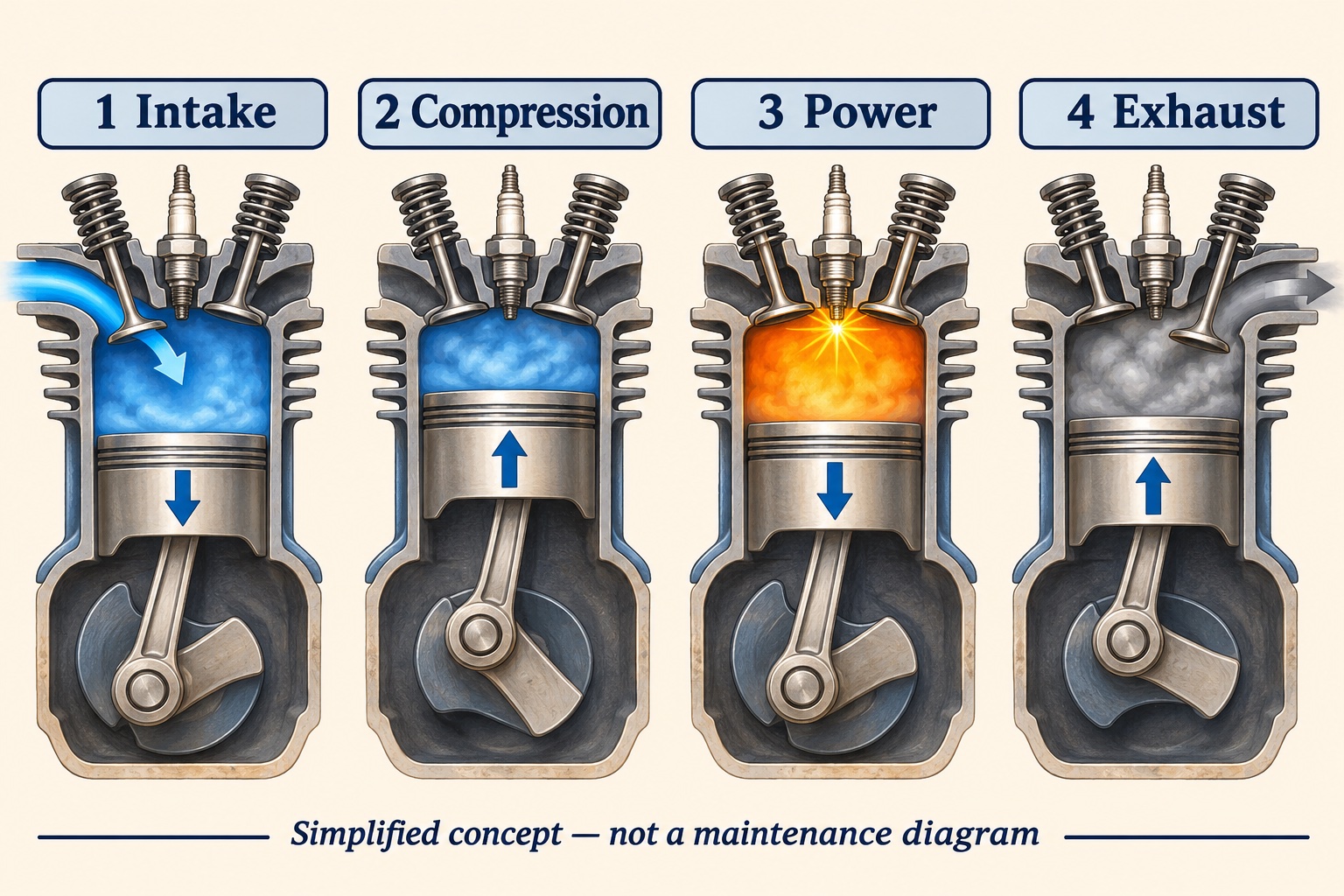
AI-generated four-stroke concept illustration. Valve timing, proportions and components are simplified; this is not a maintenance drawing.
Follow one cylinder through four strokes
During intake, the piston moves down as the intake valve admits the charge. During compression, it moves up with the valves closed. Spark ignition initiates combustion near the end of compression; expanding gases push the piston down during power. During exhaust, the piston moves up with the exhaust valve open to discharge burned gases.
The connecting rod and crankshaft convert the piston's motion into rotation. One complete four-stroke cycle takes two crankshaft revolutions. Several cylinders contribute power in sequence, and the propeller converts shaft power into thrust.
Cover the four image labels and explain what the piston and valves are doing in each panel. Then ask your instructor to help you identify the cylinders, induction system and exhaust on your airplane during a suitable ground inspection.
Connect the controls to the process
The throttle controls airflow and, with the fuel-metering system, engine power. A manual mixture control adjusts fuel relative to air. A propeller control, when installed with a constant-speed system, selects governed RPM; many basic trainers use a fixed-pitch propeller instead.
Do not transfer one airplane's control positions or leaning technique to another. Read the approved procedures for start, taxi, run-up, takeoff, climb, cruise and shutdown. For a study task, write the purpose of each control beside the relevant checklist item, then ask your instructor to check your explanation.
In a hypothetical climb, the airplane reaches less dense air while the mixture remains unchanged. Ask why the fuel-to-air relationship may need attention in a manually controlled installation, then locate the manufacturer's actual guidance. This question tests understanding; it does not supply a leaning procedure or authorize improvising one.
Separate ignition from the electrical supply
Conventional magnetos generate ignition energy independently of the airplane's normal battery and alternator supply once the engine is turning. An alternator failure therefore does not automatically mean a conventional magneto-equipped engine stops. Other equipment, including pumps or electronic ignition in different installations, may have different dependencies.
Draw two paths: the source of spark and the source of power for electrical equipment. Ask which parts of your airplane depend on each. Treat the propeller as potentially live; cockpit switch positions alone do not make handling it safe.
Learn the gauges as evidence
Build a list from your actual panel: tachometer, oil pressure and temperature, and any fuel pressure, fuel flow, manifold pressure, cylinder-head temperature or exhaust-gas temperature indications. Some trainers have only a subset. Record what each measures, its units and where the approved limits appear.
For an invented ground discussion, suppose oil pressure trends lower while oil temperature rises. Identify the relevant indications and find the approved procedure with your instructor. The pair deserves investigation; the indications alone do not establish one certain cause or a universal response.
The FAA's flight-manual chapter explains how aircraft limitations, procedures and performance information fit together. Use that structure to make your notes specific to the aircraft you fly.
Explain carburetor ice and density altitude
In carbureted engines, pressure changes and fuel vaporization can cool the induction airflow enough for ice to form even when ambient air is above freezing. Fuel-injected engines have different induction-system considerations. Learn which system is installed and the approved use of carburetor heat or alternate air.
In an invented fixed-pitch trainer scenario, RPM falls without a throttle change in moist conditions. Carburetor ice is one possibility to discuss, not a confirmed diagnosis. Locate the aircraft procedure and ask what indications it tells you to expect.
Hotter, higher conditions also affect performance. For a naturally aspirated trainer departing a high-elevation airport on a hot day, work through the approved takeoff performance data with your instructor. The FAA PHAK, particularly its aircraft-performance chapter, provides the background; generic engine theory cannot establish a safe runway requirement.
Turn the lesson into a useful review
Finish with a page covering the four strokes, control purposes, ignition source, installed gauges and the procedures you need to locate. Try systems questions in ground school, then connect the next hypothetical route to the sectional chart guide. AirspaceLab does not model every engine system or replace aircraft instruction.
Sources checked: November 14, 2026. References: FAA-H-8083-25C, Chapters 7, 9 and 11. All scenarios are hypothetical; use the applicable POH/AFM and instructor guidance for operation.